I’ve had a good first week back – thanks be to God. Rena and I have had good time to talk, walk, pray and spend time with family and friends this week. I’m still spilling over with our time in Haiti. Rena says I talk fast and nonstop when I first get back, but I can’t help it. The Lord is giving us fruit that remains for His glory, and that’s exciting to me! I also have been in touch with our Haitian team this week to look forward to our next three training conferences in July and to work on some of the details.
Before I share more news on that, I thought you may like to read two more faith stories from Haiti, both showing how believers wrestle with everyday life there.
Hebert and Nandjie’s Unselfish Decision
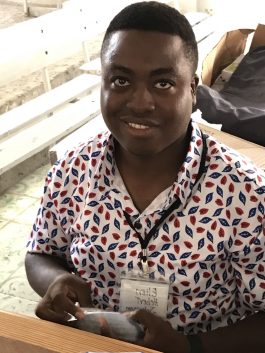
Hebert Elien Johnson is a young pastor, just getting started in ministry. He knows English quite well and has served as one of our translators for 3-4 years. Hebert loves the Lord and is in love with Nandjie (pronounced Non-jee), a wonderful Christian girl, who lives in Port au Paix. Hebert now lives and works in Gonaives, a 3-4 hour drive away over rough roads. They talk on the phone every morning and evening (at least). Cell phone reception isn’t good in Haiti, and Hebert often says “Koman?” (What?) and has to call back. But the young couple presses on despite weak cell service so they can be together via phone.
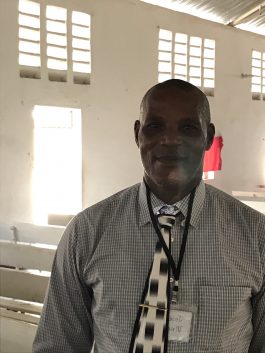
Hebert and Nandjie are looking forward to getting married, but Hebert told me that he plans to wait at least two years. I didn’t understand. Hebert is 26 and now has a steady job in Gonaives making $350 a month – a handsome sum in a country where a “good job” pays between $150 and $200 a month. So I asked him, “Why wait? Why not get married sooner?”
Hebert explained to me that he wants to help his family first. He regularly sends money to his parents to cover the cost of school for his two younger siblings. Nandjie understands and supports this unselfish decision. I know the Lord is pleased.
Ulrick’s Haunting Question
After our last day of training in Cap Haitien, our team returned to the Heberson Paradis Hotel to unwind. The training went well, and we were rejoicing in the Lord. We had worked hard, and it was time to relax.
Later that evening we gathered in Michel and Ulrick’s room to hang out and talk. Haitians love to tease and laugh, and the team was in fine form when I walked in the room. Aided by Esau’s translation, I couldn’t help joining in the fun. We teased Pastor Michel about retiring from his church (he’s 68). After sharing our ages and birthdays, I couldn’t help ribbing Hebert about his bebe face. We had a good laugh.
And we discussed the Bible, church concerns and life. Haitian pastors read the Bible a lot, and they know the content of Scripture well, including chapter and verse. God has blessed believers in Haiti with more freedom from distractions like TV, internet and stuff – thorns that, if we’re not careful, can choke out good fruit in our lives as American believers (Luke 8:14).
By nature Haitians are passionate and expressive people, pastors more so as they discuss the things of God. I wasn’t surprised when our discussion grew louder and more animated. You know Haitians are engaged when everyone talks at once – and loudly! I was trying to keep up with my limited grasp of Creole.
The pastors discussed the meaning and application of Jesus’ words in Matthew 6:33: “Seek first the kingdom of God and His righteousness, and all these things will be added to you.” What does it mean to “seek” God’s kingdom? What are “these things” that Jesus’ promises will be added to us? What about people who don’t seek God’s kingdom yet have “these things” added to them? How do we explain that? We talked about all this, pointing to many Scriptures, for nearly an hour. I loved it and added my input when appropriate.
I learned long ago that these discussions aren’t just theoretical or theological in Haiti. They address the harsh realities of everyday life there.
Near the end of our conversation, Pastor Ulrick looked across the room at me and said, “Pastor Ken, I have a question for you?” The other pastors stopped talking as Esau translated. “Do you think Haitian Christians are not seeking God’s Kingdom well enough because many of us do not have what we need?” His question broke my heart. I teared up and stammered, “No, not at all, brother. The larger political and economic problems in your country affect you and everyone in Haiti. You are seeking God’s Kingdom very well.” We sat in silence for several minutes before our conversation continued in quiet tones. Ulrick’s question has haunted my thoughts and prayers since.
Spurgeon’s Lectures to My Students captures his weekly lectures to young men training for ministry at his Bible college. His talks are personal, practical and often witty. Every church leader – and most Christians – would benefit from reading (or in my case, listening) to this classic. Although Spurgeon pastored in London in the mid-1800s, he still speaks clearly to church life today. To sharpen my tools for encouraging and training church leaders in Haiti, I wanted to refresh my memory of Spurgeon’s biblical and practical advice to young pastors. I wasn’t disappointed.
What a gem! Dr. Nevius speaks biblically and practically to church life and leadership today in the United States and in countries like Haiti. His main point in the book is that Christians like us from wealthy nations should be super-careful in how we use mission money in poor countries. Specifically, he’s convinced by long experience that our paying or “sponsoring” pastors and other church workers in poor nations makes a mess. It creates dependency, expectations, laziness, disrespect, and jealousy among other negative results for gospel work. We end up with “mercenary pastors and Christians.” And, man, have I seen this in Haiti – and heard and read about it in countries around the world. With the best of intentions, we can do more harm than good for the progress of the gospel, discipling of believers, and training of church leaders. We need to give generously but invest wisely in training and resourcing – precisely what PPI is committed to in Haiti and other developing nations.
While in Haiti, I used the little free time we had to focus on learning more Creole – speaking with our team, looking up words in my travel-sized Haitian dictionary and writing notes. Being immersed in the language with our Haitian team moved me forward piti piti (“little by little”)!
Diana mentioned that our former neighbor was coming into town that evening and would love to see us. This neighbor and friend is Jewish. We had a good connection when we lived here and had opportunities to share gospel truth with her and her husband as we spent time together. So later that evening we met with her and two other friends to catch up on life, listen, love and encourage. We talked until after midnight. Unexpected and sweet gifts from the Lord!


I grew up with grits, you know, the white hominy breakfast food. Called mayi (“corn”) in Creole, these grits were made over a charcoal fire, seasoned with Haitian spices with bits of shrimp thrown in for good measure. Your mama never made grits like this – and they are tasty! Other breakfast foods are spaghetti without sauce but spiced well, ze (eggs) served with lettuce, sliced tomatoes, onions and green peppers. This latter was my go-to to keep my stomach in order. I’ve learned to eat light when I go to Haiti – a little breakfast with coffee and a small lunch of chicken and rice. That keeps me healthy and happy through the days of training!
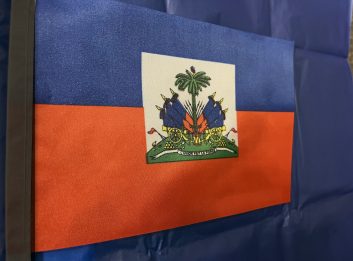
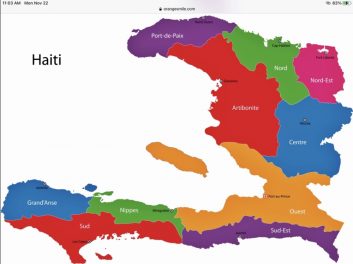
Gonaives lies on the northwest coast of Haiti about 100 miles from Cuba and is the capital of the Artibonite Department. This city of 300,000 people sits on flat land at sea level, making it vulnerable to hurricanes and their resulting tidal waves. In 2004, Tropical Storm Jean sent a storm surge 10 miles inland that flooded the entire city and killed 3000 people. Church leaders still talk about it. Gonaives also is known as the birthplace of Haitian independence because Haitian slave leader, Jean-Jacques Dessalines, read Haiti’s declaration of independence from France on January 1, 1804. Haitians celebrate their independence day by eating simple, tasty soup called joumou that commemorates their humble beginnings as a nation.
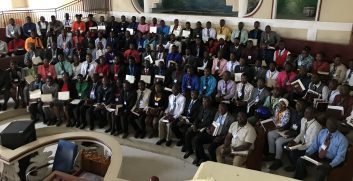
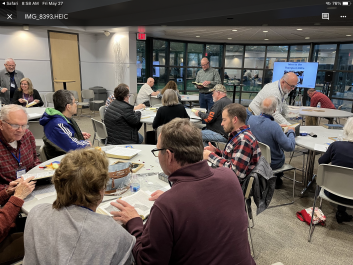
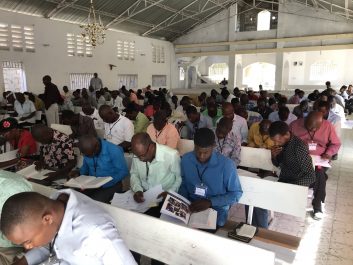
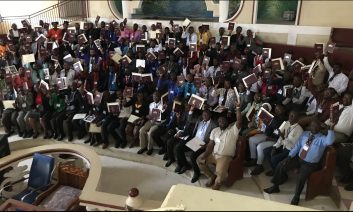
We finished training 115 pastors in Gonaives a few hours ago.
Pastors who came to this training from other cities pleaded with us to bring PPI training to their cities. We asked them to pray for us and told them that our team will meet tomorrow morning to pray and talk about our next cities.
I’ll also talk more with our team tomorrow about their part in leading training sessions and, soon enough, entires days of the training. Hebert led a review on day one, and Esau led all of Session 7. Both did well. Esau taught especially well. Pastors respect him, and he interacted with them so well today, encouraging their responses and reinforcing their learning. Mentoring and coaching pastors to lead PPI training, especially Course 1, remains high on my and our Board’s priority list. We made good progress toward that goal on this trip!